5-a-Side Positions Explained: Who Goes Where
· 6 min read · KIKOFF Football

If you have ever turned up to a 5-a-side game and had no idea whether you were meant to defend, attack, or just stand somewhere useful, you are not alone. Unlike 11-a-side football, 5-a-side positions are looser and the game moves faster. There is usually a keeper, two players who sit back, and two who push forward. But the real secret is not a formation diagram. It is rolling subs, communication, and staying switched on for short bursts. This guide covers the basics of 5-a-side positions and tactics for beginners, plus where to actually play in Sydney.
What are 5-a-side positions, really
5-a-side is a small-sided version of football played with five players per team, including the keeper. Most casual games settle into a simple shape: one keeper, two defenders, two attackers. That is it. There is no need to memorise wing-back roles or false nines. The pitch is small, the game is quick, and players naturally drift into space rather than holding rigid lines.
For beginners, the useful way to think about 5-a-side tactics is less about shape and more about jobs. Someone needs to stay back when the ball is lost. Someone needs to be ready to receive it when it is won back. Everything else sorts itself out with a bit of communication.
Keeper, two at the back, two up top
The most common 5-a-side formation is a flat 2-2 in front of the keeper. Here is how the roles usually break down.
- Keeper: On a caged pitch, the keeper also acts as an outlet. The ball stays in play off the walls, so keepers often start attacks by rolling or throwing to a defender rather than booting it long.
- Two defenders: Their main job is staying goal-side and recovering quickly. In a caged game, rebounds off the walls mean defenders need to track the ball, not just mark a player.
- Two attackers: They look for space in behind and support each other so one is never isolated. Swapping positions with a defender during a phase of play is normal and expected.
None of this needs to be rigid. The best 5-a-side players for beginners to copy are the ones who defend when their team loses the ball and attack when it is won, regardless of where they started.
Why rolling subs matter more than formation
Here is the part most beginner guides skip. In social 5-a-side, games are usually played with rolling subs, meaning players rotate in and out throughout the match rather than waiting for a break in play. This changes everything about how you should think about position.
A tidy 2-2 shape on a whiteboard means very little if your legs are gone after four minutes of sprinting. Rolling subs let you play at a higher intensity in short bursts, then rest, then go again. The teams that look organised are usually just the ones subbing early and often, not the ones with a clever tactic.
So if you are new to the format, worry less about exact positioning and more about two things: communicating with whoever is near you, and coming off before you are cooked. That is 90 per cent of beginner 5-a-side tactics sorted.
Where to play 5-a-side in Sydney
KIKOFF runs caged 5-a-side at two Sydney venues, plus open-pitch 6-a-side at a third if you want to compare formats.
- KIKOFF Canterbury at Lakemba has four caged 5-a-side pitches, floodlit and open year-round. The cage means the ball stays in play off the walls, so games flow fast with fewer stoppages.
- KIKOFF Northern Beaches at Curl Curl has four caged 5-a-side pitches with futsal line markings, also open year-round. You can play soccer or futsal rules here, which is worth knowing if your crew is keen on both.
- KIKOFF Eastern Suburbs at Eastgardens runs open-pitch 6-a-side, seasonally from September to December. It is a different format to the caged games, with kick-in restarts instead of wall rebounds.
The bookable thing: open competitions
If you want a regular weeknight game rather than a one-off, KIKOFF runs open adult competitions at both Northern Beaches and Eastern Suburbs, with the Northern Beaches leagues run alongside our partner NBFA.
At Northern Beaches, the current season includes Monday Over 35 Mens, Monday Ladies 5, Tuesday Ladies 1/2, Tuesday Over 40s Mixed, Wednesday Ladies 3/4, Wednesday Mixed KIKOFF, and Thursday Mens 6. These all run from Monday 7 September 2026 to Sunday 20 December 2026, with team entry at $1,700 and registration currently open.
At Eastern Suburbs, Wednesday Mens Division 2, Monday Mens Division 2, Monday Mens Division 1 and Wednesday Mens Division 1 are all under way, running Monday 28 September 2026 to Friday 18 December 2026. Team entry is $1,800 with individual entry at $295 if you do not have a full squad. There is also a Monday Mens Mini seven-week season with team entry at $1,200 or individual entry at $250.
How to get involved: team vs individual
Most of these competitions accept team registration, and several also take individual sign-ups if you are on your own. If you are new to the format, individual registration is the easiest way in. You get placed into a team, turn up, and work out positions with your new teammates on the night.
- Check the competition night and venue that suits your week.
- Register as a team if you already have one, or individually if you are solo.
- Bring boots suited to synthetic turf, shin pads, and a light and dark shirt if you do not have a kit yet.
- Arrive early for your first game to meet teammates and get a feel for the cage or open pitch before kick-off.
On the night itself, expect short games, constant rotation through rolling subs, and a pace that rewards short sharp runs over long sprints.
FAQs
What are the standard 5-a-side positions?
Most social 5-a-side games use one keeper, two defenders, and two attackers. This is not a strict rule, just the shape that works best on a small pitch. Players often swap between defending and attacking during play rather than sticking rigidly to one role.
Do I need to know tactics to play 5-a-side as a beginner?
No. Basic awareness of your position and good communication with teammates matters far more than set tactics. Rolling subs mean energy management is often more important than formation on the night.
What is the difference between 5-a-side and 6-a-side?
5-a-side is typically played in a caged pitch with the ball staying in play off the walls. 6-a-side is often played on an open pitch with kick-in restarts instead of wall rebounds. Both are small-sided formats but the flow of the game differs.
Where can I play 5-a-side in Sydney?
KIKOFF runs caged 5-a-side at Canterbury in Lakemba and at Northern Beaches in Curl Curl, both open year-round. Northern Beaches pitches also have futsal line markings for soccer or futsal.
Can I join a 5-a-side competition without a full team?
Yes, several KIKOFF competitions accept individual registration alongside team entry. You will be placed into a team for the season, which is a straightforward way to start playing regularly without organising a full squad yourself.
Is the keeper position different in caged 5-a-side?
Yes. Because the ball stays in play off the walls in a cage, keepers often distribute by rolling or throwing to a nearby defender rather than kicking long, since rebounds keep the game moving quickly.
If you are ready to find a weeknight game that suits you, explore the open 5-a-side and 6-a-side competitions running now. For a plain-English rundown of how each format works before you commit, read our guide to available formats.
Keep reading
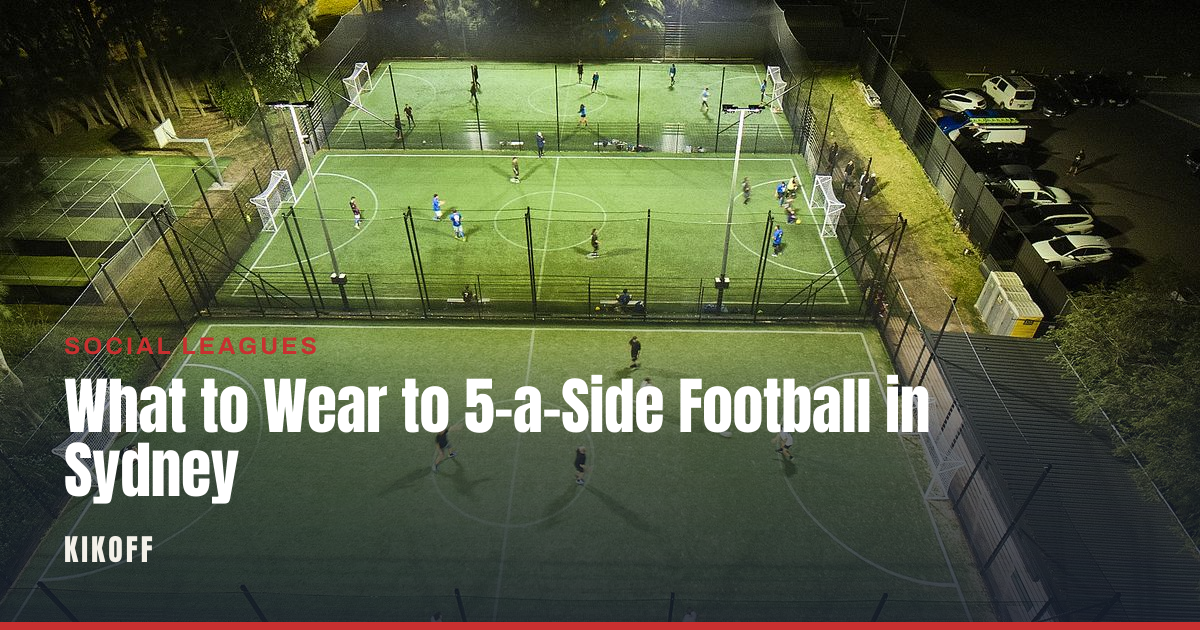
What to Wear to 5-a-Side Football in Sydney
A plain kit list for your first weeknight social game: footwear, shin pads, clothes and water. Separate notes for adult social players and kids nights on KIKOFF's synthetic pitches.

Your First 5-a-Side Game: What to Expect on Night One
New to social 5-a-side and not sure what to expect on the night. Here's a plain rundown of arrival, kit, subs and refereeing so you can just turn up and play.

Kids Playing Soccer Twice a Week: A Sample Family Week
Many Sydney families now have kids playing soccer twice a week, pairing Saturday club with one relaxed weeknight game or coaching session. Here's how that balance actually looks, plus where to check fixtures and book in.